Physics 1 Practice

Unit 7 of 8

Torque and Rotational Motion

Torque, rotational inertia, rotational kinematics, static equilibrium, and angular momentum.

10 problems: 4 multiple choice, 2 multiple select, 4 free response. Use g = 10 m/s² throughout.

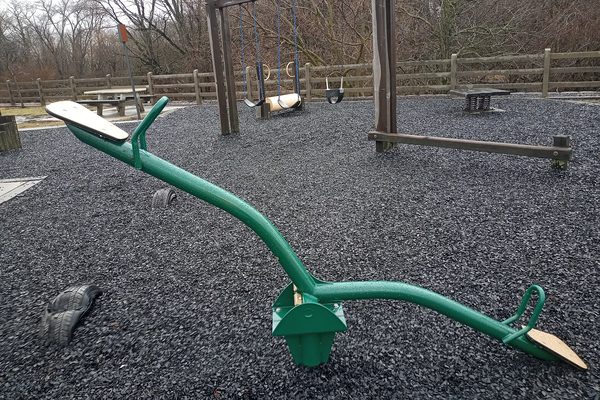
A green metal teeter-totter balanced on its central pivot in a playground covered with black rubber mulch

Photo: Visviva, CC0 1.0 Universal Public Domain Dedication. Image credits

Overview

Rotational motion has its own version of each quantity you already know. Angle plays the role of position, angular velocity ω plays the role of velocity, and angular acceleration α plays the role of acceleration. Every point on a rigid spinning object has the same angular velocity, but points farther from the axis move faster: v = r ω.

Torque is the turning effect of a force. It depends on how hard you push, how far from the axis you push, and at what angle: τ = r F sin θ. That's why door handles sit far from the hinges and why a longer wrench loosens a stuck bolt. Rotational inertia, I, measures how hard it is to change an object's rotation. It depends on the mass and on how far that mass is from the axis.

The rotational form of Newton's second law is Σ τ = I α. An object in static equilibrium has zero net force and zero net torque about every axis, so you can pick whatever pivot point makes the math easiest. When no outside torque acts, angular momentum, L = I ω, stays constant, which is why pulling mass in toward the axis makes an object spin faster.

Key equations

EquationWhat it’s for
τ = r F sin θTorque. r runs from the axis to where the force acts; θ is the angle between r and F.
Σ τ = I αNewton’s second law for rotation.
ω = ω0 + α tAngular velocity with constant angular acceleration.
Δ θ = ω0 t + ½ α t2Angular displacement with constant angular acceleration.
v = r ωLinear speed of a point a distance r from the axis.
L = I ωAngular momentum. The change in L equals τ Δ t.
K = ½ I ω2Rotational kinetic energy.
I = Σ m r2Rotational inertia of point masses. Hoop: M R2. Solid disk: ½ M R2.

All of these are on the printable equation sheet.

Common mistakes

  • Using the wrong distance for torque. Measure from the axis to the point where the force acts, and use only the part of the force perpendicular to that line.
  • Thinking rotational inertia depends only on mass. Where the mass sits matters just as much.
  • Forgetting that every point on a rigid object has the same angular velocity, even though points farther out move faster.
  • Leaving out the object's own weight in equilibrium problems. For a uniform beam, the weight acts at the center.
  • Assuming kinetic energy is conserved when a spinning skater pulls in her arms. Angular momentum is conserved; her rotational kinetic energy goes up because she does work pulling her arms in.

Practice problems

Work each problem on paper before opening its solution. Multiple-select problems have exactly two correct answers.

1Problem 1, Multiple choice

  • Calculation

A 30 kg child sits 2.0 m from the pivot of a seesaw. How far from the pivot, on the other side, must a 40 kg child sit to balance the seesaw?

  1. Choice A: 1.0 m
  2. Choice B: 1.5 m
  3. Choice C: 2.0 m
  4. Choice D: 2.7 m
Show solutionHide solution

Worked solution

For balance, the torques about the pivot are equal and opposite: m1 g r1 = m2 g r2.

(30)(2.0) = (40) r2, so r2 = 60/40 = 1.5 m.

Choice D has the ratio upside down. A heavier child has to sit closer to the pivot, not farther.

Answer: B.

2Problem 2, Multiple choice

  • Conceptual

A student uses a wrench to loosen a stuck bolt. Each force shown has the same magnitude. Which one produces the greatest torque on the bolt?

boltABCD45°
  1. Choice A: A
  2. Choice B: B
  3. Choice C: C
  4. Choice D: D
Show solutionHide solution

Worked solution

τ = r F sin θ. All the forces have the same F, so compare r and θ.

A is perpendicular, but at only half the distance. B is perpendicular at the full distance. C points along the handle (θ = 0), so it produces no torque. D is at the full distance, but only sin 45° ≈ 0.71 of it is perpendicular.

Answer: B.

3Problem 3, Free response

  • Ranking
Four forces are applied, one at a time, to a door that is free to rotate about its hinges. The distance is measured from the hinge line to where the force is applied, and the angle is between the door and the force.
CaseForceDistance from hingeAngle
A10 N0.80 m90°
B20 N0.40 m90°
C20 N0.80 m30°
D5.0 N0.80 m90°
  1. Rank the cases by the magnitude of the torque about the hinges, from greatest to least.
  2. For case C, show two different ways to find the torque.
Show solutionHide solution

Model answer

(a) τ = r F sin θ. A: (0.80)(10)(1) = 8.0 N·m. B: (0.40)(20)(1) = 8.0 N·m. C: (0.80)(20)(0.50) = 8.0 N·m. D: (0.80)(5.0)(1) = 4.0 N·m.

Ranking: A = B = C > D.

(b) Method 1, perpendicular component of the force: F sin 30° = 10 N acting 0.80 m from the hinge, so τ = (10)(0.80) = 8.0 N·m.

Method 2, lever arm: the perpendicular distance from the hinge to the line of the force is (0.80)sin 30° = 0.40 m, so τ = (20)(0.40) = 8.0 N·m.

4Problem 4, Multiple choice

  • Predict & explain

A hoop and a solid disk have the same mass and the same radius. They are released from rest side by side at the top of a ramp and roll without slipping. Which one reaches the bottom first?

  1. Choice A: The hoop
  2. Choice B: The disk
  3. Choice C: They tie.
  4. Choice D: It depends on their mass.
Show solutionHide solution

Worked solution

Both lose the same gravitational potential energy, which becomes translational plus rotational kinetic energy.

The hoop's mass is all at the rim (I = M R2). The disk's mass is spread toward the center (I = ½ M R2). For the same speed, the hoop needs more rotational kinetic energy.

So the hoop has less energy left for moving forward and travels more slowly at every point. The disk wins. Mass doesn't matter, since it cancels for every object with the same shape.

Answer: B.

5Problem 5, Multiple select

  • Conceptual
  • Which changes

A skater spins on ice with her arms out, then pulls her arms in close to her body. Ignore friction from the ice. Which two statements are correct? Select two answers.

  1. Choice A: Her angular momentum stays the same.
  2. Choice B: Her angular speed increases.
  3. Choice C: Her rotational kinetic energy stays the same.
  4. Choice D: Her rotational inertia increases.
Show solutionHide solution

Worked solution

With no external torque, angular momentum L = I ω is conserved. A is correct.

Pulling her arms in moves mass closer to the axis, so her rotational inertia decreases (D is wrong) and her angular speed must increase (B is correct).

Rotational kinetic energy can be written K = L2/2I. With L fixed and I smaller, K increases. The extra energy comes from the work her muscles do pulling her arms in. C is wrong.

Answers: A and B.

6Problem 6, Free response

  • Calculation
  • Which changes
A disk with a rotational inertia of 0.20 kg·m² starts at rest. A constant net torque of 1.0 N·m acts on it for 4.0 s.
  1. Find the angular acceleration.
  2. Find the angular velocity at the end of the 4.0 s.
  3. Find the angular momentum at the end of the 4.0 s in two different ways.
  4. The same torque acts for the same time on a disk with twice the rotational inertia. Which of your answers to (a) through (c) change, and how?
Show solutionHide solution

Model answer

(a) α = τ / I = 1.0/0.20 = 5.0 rad/s².

(b) ω = α t = (5.0)(4.0) = 20 rad/s.

(c) L = I ω = (0.20)(20) = 4.0 kg·m²/s. Or, from the angular impulse: Δ L = τ Δ t = (1.0)(4.0) = 4.0 kg·m²/s.

(d) The angular acceleration and the final angular velocity are each cut in half: 2.5 rad/s² and 10 rad/s. The angular momentum doesn't change. It is still τ Δ t = 4.0 kg·m²/s, because the same torque acted for the same time.

7Problem 7, Multiple choice

  • Graph

The graph shows the angular velocity of a wheel. Through what total angle does the wheel turn from t = 0 to t = 5 s?

01234504812time (s)angular velocity (rad/s)
  1. Choice A: 18 rad
  2. Choice B: 24 rad
  3. Choice C: 42 rad
  4. Choice D: 60 rad
Show solutionHide solution

Worked solution

Angular displacement is the area under an angular velocity–time graph, just as displacement is the area under a velocity–time graph.

From 0 to 3 s: ½(3)(12) = 18 rad. From 3 to 5 s: (2)(12) = 24 rad. Total: 42 rad.

Choice D assumes 12 rad/s for the full 5 s.

Answer: C.

8Problem 8, Free response

  • Calculation
  • Which changes
A uniform 4.0 m beam with a mass of 10 kg rests on supports at its two ends. A 20 kg box sits on the beam 1.0 m from the left end.
  1. Describe the forces on the beam, as you would draw them on a free-body diagram, including where each acts.
  2. Find the force each support exerts on the beam.
  3. Without calculating, describe how the two support forces change if the box slides toward the right end. Explain.
20 kg1.0 m4.0 m (beam mass 10 kg)
Show solutionHide solution

Model answer

(a) The beam's weight, 100 N down, at its center (2.0 m from the left end). The box pushing down with 200 N at 1.0 m from the left end. The left support pushing up with FL at the left end. The right support pushing up with FR at the right end.

(b) Take torques about the left end, so FL drops out: FR (4.0) = (100)(2.0) + (200)(1.0) = 400 N·m, so FR = 100 N. The forces must also balance: FL + FR = 300 N, so FL = 200 N.

Check with torques about the right end: FL (4.0) = (100)(2.0) + (200)(3.0) = 800 N·m, which gives FL = 200 N.

(c) As the box moves right, its torque about the left end grows, so FR increases. The total still has to be 300 N, so FL decreases by the same amount. The support nearer the box carries more of its weight.

9Problem 9, Free response

  • Experimental design
Design an experiment to find the rotational inertia of a bicycle wheel that spins on a fixed horizontal axle. A string is wrapped around a hub of known radius r, and hanging masses can be attached to the end of the string. You also have a meterstick and a stopwatch.
  1. Describe your procedure.
  2. Explain how you would calculate the rotational inertia from your measurements.
  3. Explain how using several hanging masses and a graph could reduce the effect of friction in the axle.
Show solutionHide solution

Model answer

(a) Attach a hanging mass m and release it from rest. Measure the distance d it falls and the time t it takes. Repeat several times and average. Then repeat with several different masses.

(b) The mass starts from rest, so its acceleration is a = 2d/t2. The string unwinds from the hub, so the wheel's angular acceleration is α = a/r. For the hanging mass, m g − T = m a, so the tension is T = m(g − a). The tension's torque on the wheel is τ = T r. Then I = τ / α.

(c) Graph the string's torque τ against α for several masses. If friction exerts a roughly constant torque, then τ − τfriction = I α, and the graph is a straight line with slope I. The friction torque only shifts the line up (it becomes the vertical intercept), so the slope still gives I.

10Problem 10, Multiple select

  • Conceptual

Two children ride a merry-go-round that turns at a constant rate. Child 1 sits at the edge. Child 2 sits halfway between the center and the edge. Which two statements are correct? Select two answers.

  1. Choice A: Both children have the same angular speed.
  2. Choice B: Child 1’s linear speed is twice child 2’s.
  3. Choice C: Both children have the same linear speed.
  4. Choice D: Child 2 has the larger centripetal acceleration.
Show solutionHide solution

Worked solution

Both children go around once in the same time, so they have the same angular speed. A is correct.

v = r ω. Child 1 is twice as far from the center, so child 1 moves twice as fast. B is correct and C is wrong.

Centripetal acceleration is r ω2, which is larger for child 1, so D is wrong.

Answers: A and B.